It was mid-morning, not yet late enough for the Georgia humidity to make being outdoors unbearable in the early summer. Morgan Geurts was starting her day as she did any other when home from the University of Georgia: with a run through her Atlanta neighborhood.
She stepped out of her driveway and started running. She loved the familiarity of her morning runs, the neighborhood she had grown up in, the same route she had been running since she first began training for the high school cross-country team. It was peaceful.
Until suddenly it wasn’t.
Morgan lived in a fairly large subdivision, with many different streets and multiple stop signs. About a third of the way into her run, Morgan realized that a car she had passed at a stop sign earlier was following her. She did not recognize the car, but it had slowly been tracking her as she ran.
Before she knew it, she was trapped.
She had reached the outlet of her neighborhood, the spot where she normally turned around to run back towards home. Slowing as she ran up the stop sign, she was faced with a dilemma. To her left was the busy highway, cars racing by. To her right the car she didn’t recognize, parked in the street waiting for her.
Morgan had no choice but to run past the car to get back home. It was her only way back into the neighborhood. She felt a sickening in her stomach, the seriousness of her situation closing in around her.
“It was really scary; it was clearly just waiting for me. Something in me was screaming at me not to run past it but I was stuck, I didn’t know what to do”.
To Morgan’s relief a neighbor she recognized drove past the strange car and stopped next to her. The good Samaritan had been pulling out of their driveway and noticed the strange car following her. They picked her up and drove her back home. She was safe.
But what if the neighbor had not been there?
According to the National Human Trafficking Hotline, 4,585 human trafficking cases were reported in the United States in 2019.
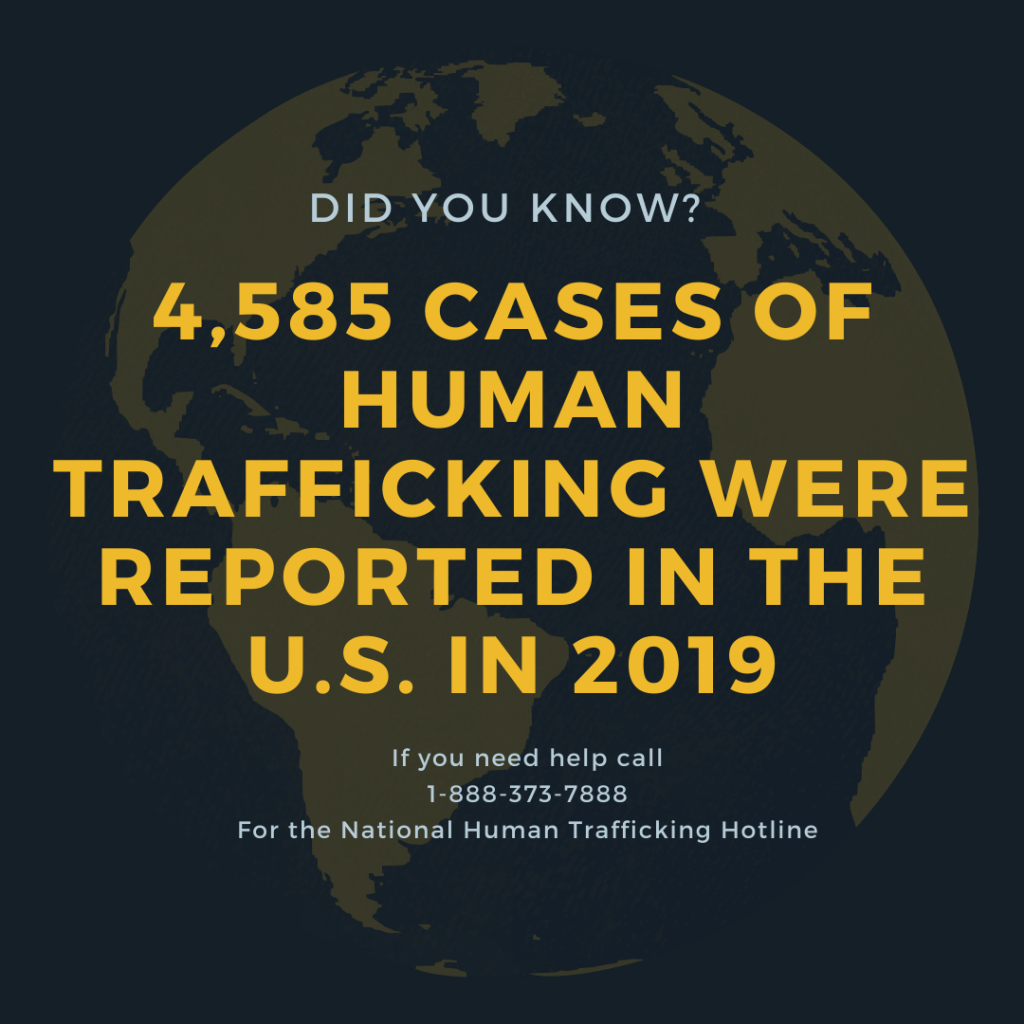
Human trafficking is the act or practice of illegally transporting people from one place to another, typically for the purposes of forced labor or sexual exploitation. These cases represent direct situations of trafficking being reported to the hotline via call, text, email, online report, or webchat and can involve one or more potential victims. According to the Georgia Attorney General’s office, “human trafficking is a multi-billion criminal enterprise [and] is the fastest growing crime in the world”.
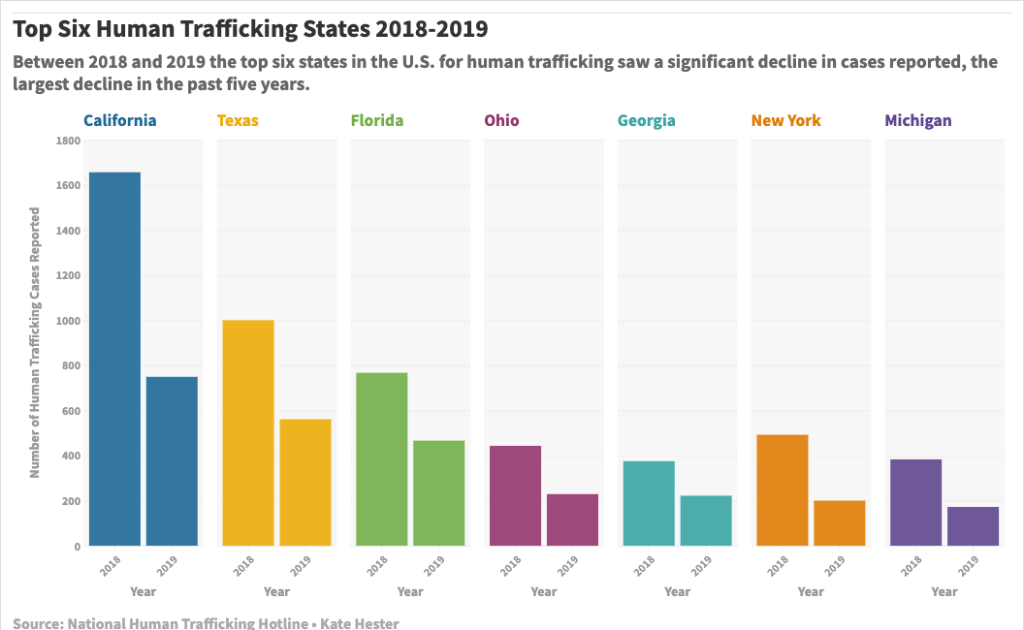
Georgia is one of the top six states for reported human trafficking cases, with 1,346 cases reported from 2015-2019. However, the data collected by the National Human Trafficking Hotline shows that there was a significant decrease in reported cases from 2018-2019. California, the state with the largest number of cases reported, dropped from 1,656 to 749 and Georgia dropped from 375 to 222 reported cases.
Alyssa Kiss has been researching human trafficking trends in Georgia for the past two years, “lots of times people know it’s happening, but they don’t necessarily know the details”. Kiss, a senior research assistant at the University of Georgia, has been working to create easily digestible data visualizations such as heat maps to show where in Georgia cases are prevalent. She says that Atlanta, home of Hartsfield-Jackson International Airport is a hot spot for trafficking, “it’s happening near airports and it’s happening near big interstates like I-20”.
Kiss is a young woman with a lot of strength. She and her partner spent months researching, studying court cases and hearing victims’ stories; “it’s a hard thing to digest that’s happening, we had moments going over these stories where we just broke down and cried”. Her hope is that her visualizations will help her neighbors to realize that human trafficking is happening right in their backyard.
“Anyone can be trafficked”
David Okech
The Georgia Attorney General’s office states that the average age of entry for human trafficking victims is 12-14 years old. Human trafficking expert David Okech agrees, he explains that “anyone can be trafficked” but the majority of victims are women and children, and that children are much more likely to be trafficked than adults.
Originally hired as an associate professor at the University of Georgia’s School of Social Work for his research in asset building in the United States, the bookshelves in Okech’s office yield row after row of books on human trafficking and the history of slavery in Africa. He is now the director of the African Programming and Research Initiative to End Slavery(APRIES), oversees human trafficking research at UGA, and works with students like Kiss to measurably estimate the prevalence of human trafficking worldwide.
Okech changed his area of research to human trafficking after he became involved with a study abroad program to Ghana. A part of this program involved working with a rehabilitation care facility for girls who had been trafficked and exploited called Lifeline. The impact of seeing these girls over and over again sparked a fire inside Okech, and drove him to completely change his area of research in an effort to do more for these young women.
Despite the vast number of people that have been trafficked, there are only two types of trafficking: sex and labor. Looking at trafficking data collected in the United States, the numbers of sex trafficking cases far outweigh the number of labor trafficking cases with 3,266 sex cases and 525 labor cases in 2019.
However, Okech says that these numbers are skewed. He explains how many scholars argue that there are more people being trafficked for labor than for sex. While there are distinct differences between sex and labor, the two are not always mutually exclusive.
“You can be trafficked for labor and end up being exploited for sex, you can be trafficked for sex, and actually in one way if you are being trafficked for sex you are going to work, it’s like labor”, says Okech. Victims trafficked for sex often end up in the prostitution industry, working in brothels or strip clubs, where they are exploited for labor as well as sex. Victims trafficked for labor can be raped because they have lost all agency.
Okech says that after interviewing various people, he has found that quite a number of people have experienced both types of exploitations even though one may have been more prevalent than the other. Therefore, the numbers for both labor trafficking and sex trafficking are warped.
Trafficking does not exist in isolation.
David Okech
One underlying factor that connects human trafficking across the world: poverty. According to The World Poverty Clock, over six million people are living in poverty. “Trafficking does not exist in isolation. Trafficking exists because of poverty so it is very difficult to escape trafficking unless you escape poverty” says Okech. America is not exempt from this, based on the U.S. Census Bureau’s 2017 estimates The Center for Poverty Research says that that year about 39.7 million Americans lived in poverty.
Okech is now the director of the African Programming and Research Initiative to End Slavery (APRIES) housed at UGA and recently received a $15.75 million dollar grant from the U.S. Department of State to further his program. He oversees human trafficking research at UGA, with the goal to measurably estimate the prevalence of human trafficking worldwide.
Even though there are only two types of trafficking, there are many scenarios in which a person can be exploited and end up in a trafficking situation. In Africa, children are exploited for domestic servitude by their relatives or teachers. There are also cases where people are trying to cross borders and pay smugglers to get them from point A to point B, but if something goes wrong with the payment the smugglers will sell them instead. In China, young women are trapped in rooms with video cameras and exploited across the internet. In America, prostitutes are sent by their pimps to the hotel room of the highest bidder.
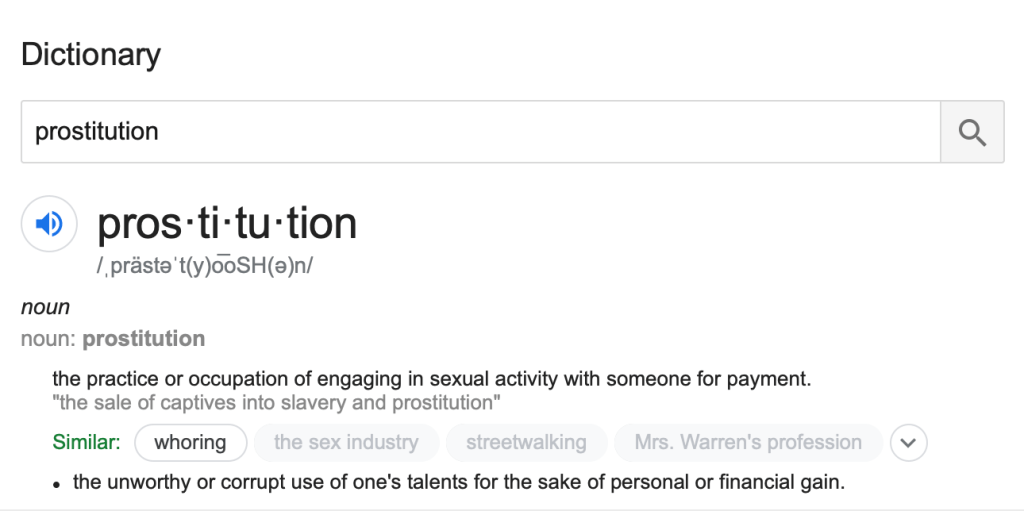
The Oxford-English Dictionary defines prostitution as the practice or occupation of engaging in sexual activity with someone for payment. Prostitution is illegal in the United States and according to Kiss, if you are a juvenile engaging in prostitution you are automatically considered to be trafficked in the state of Georgia.
Law enforcement in Georgia has been working tirelessly to rescue these children from their captors. Their work often culminates in the form of sting operations. While Atlanta is the hotspot for human trafficking in Georgia, a number of these operations have taken place in Athens. In 2012, undercover officers arranged to meet prostitutes employed by known Archie Byrd III at the Holiday Inn Express on West Broad Street.
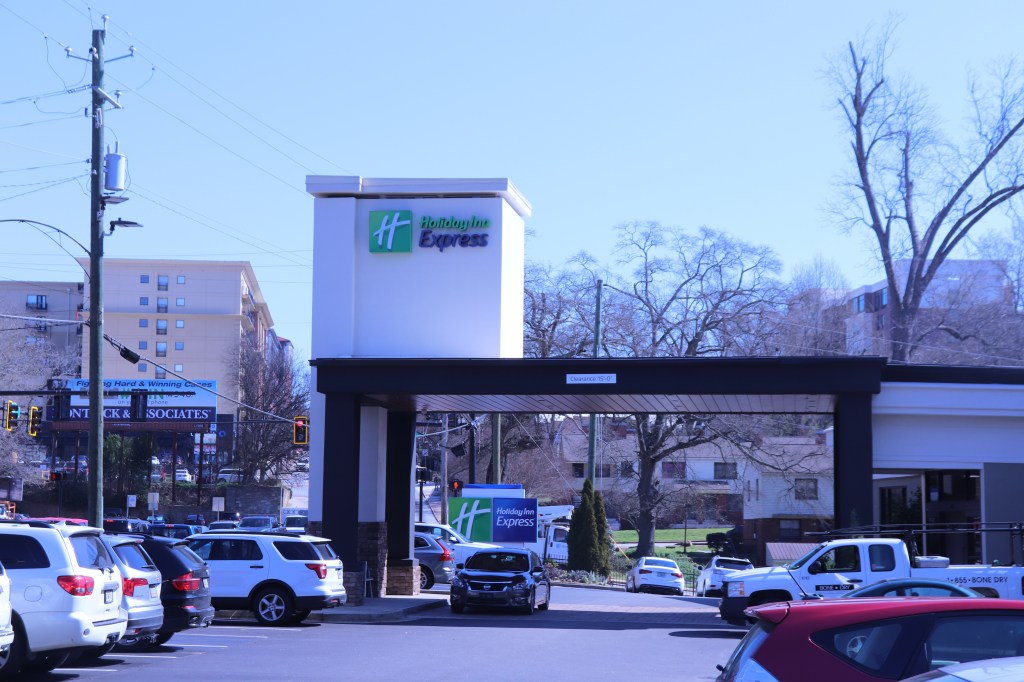
Arriving to the hotel room the officers discovered two adult female prostitutes, Byrd, and an underage teenage girl. Byrd and one prostitute escaped but police arrested the other and rescued the underage teen. The escaped criminals were later captured reported the Athens Banner-Herald, and Byrd was found guilty on six counts of trafficking persons for sexual servitude.
The Banner-Herald also reported on a similar operation that took place less than a block away from the Holiday Inn Express at the Days Inn on the corner of North Finley Street and Reese Street in 2016.
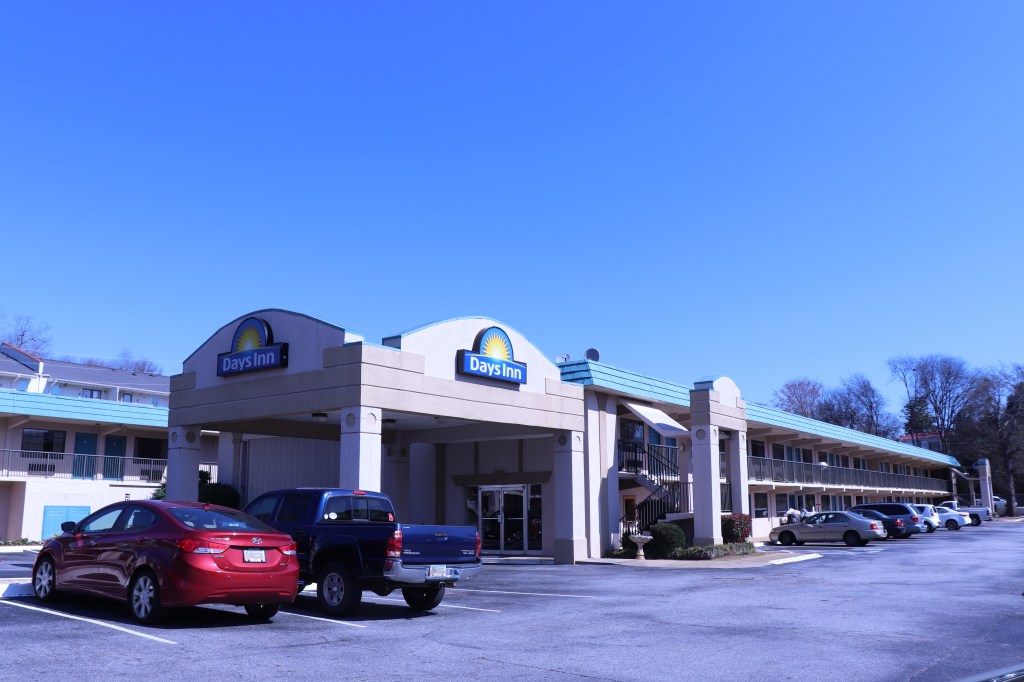
Responding to a call about a 16-year-old girl from New York being sold for sexual favors, Athens-Clarke County police arrested two suspects and rescued the young girl in the hotel. Later, additional suspects and another juvenile girl being trafficked who had escaped police custody at the hotel where apprehended in Florida.
Athens has only continued to be a dangerous place for human traffickers. In July of 2019 Fox 5 reported that nine suspects were arrested thanks to an undercover operation led by the FBI.
Children are not the only victims of trafficking in Georgia. The summer of 2019 yielded the recovery of 103 child victims across the nation after a month-long FBI operation said the Atlanta Journal Constitution. The operation involved over 400 agencies and 67 sex traffickers were arrested. Seven of the child victims were recovered in Georgia along with four adult victims of trafficking.
There are a number of programs in place for victims when they escape trafficking. There are safe houses for victims to stay in as they transition back into everyday life or while they wait for their captors to be arrested or convicted. Athens is home to The Cottage, a sexual assault and children’s advocacy center that works with trafficking victims. Redemption Inkbased in Atlanta is a non-profit that connects survivors with participating tattoo parlors that offer free tattoo coverups to victims.
A tattoo parlor might not be people’s first thought when they think of recovery, but for many trafficking victims, it is.
Many victims of sex trafficking receive homemade tattoos marking their ownership. Jim Mellor has come to recognize one of these tattoos immediately, “there’s different symbols, letters and numbers that are affiliation with the ownership of the individual. They’re basically being branded like a piece of cattle”.
Picture a big teddy bear, one that is fluffy and lovable with a bright heartwarming smile that people cannot help but smile back at. Now picture that same teddy bear but covered in tattoos, a small gold hoop in between its nostrils, a long fluffy beard, and gauges in its big ears. Jim Mellor is that teddy bear. Mellor and his wife own and operate 3 Ravens Tattoo and Piercing in downtown Athens, one of Redemption Ink’s participating salons.
The studio has been participating for the past two and a half years and Mellor and his wife cover all of the costs themselves. They want the victims to know that their community stand behind them. When a victim comes in, Mellor is ready to go. His welcoming smile beckons them into the bright studio. The small space feels big and open with white walls and a single large window taking up the majority of the front wall.
The tattoos of the victims are often behind the ear or neck, on the wrist, hand or collarbone; “they are always on the smaller side, generally within the size of an apple or smaller”. Mellor says that the majority are done in a non-sanitary environment and often leave scars making removal more difficult. He makes sure to always ink on their new tattoo in one sitting so they can leave his studio with a fresh start.
Kiss, Okech, and Mellor share a common goal: awareness. Each has made bringing awareness to the threat of human trafficking a priority in their lives. Human trafficking is not unknown to the government, every state has laws in place to combat the threat, but the citizens are unaware of the danger. Through the work of these three people, the public has gained better knowledge and understanding of a backyard threat.
 Kate Hester