April 29, 2019
ATHENS, Ga – Picture this. You are back in high school, specifically science class. The bell rings and everyone turns to face the teacher. You can be in any class you choose; biology, chemistry, physics, just so long as it is a science course. Class begins and the teacher gives a brief background on the history of the concept you are learning about. They start to talk about the person who made this groundbreaking discovery, the person who opened the door for future generations, the person who took science to a whole new level, the person who was the first. Who do you picture? Maybe Thomas Edison, Charles Darwin, Marie Curie, or Albert Einstein. University of Georgia student Ashley Rasys has secured her spot among these greats.
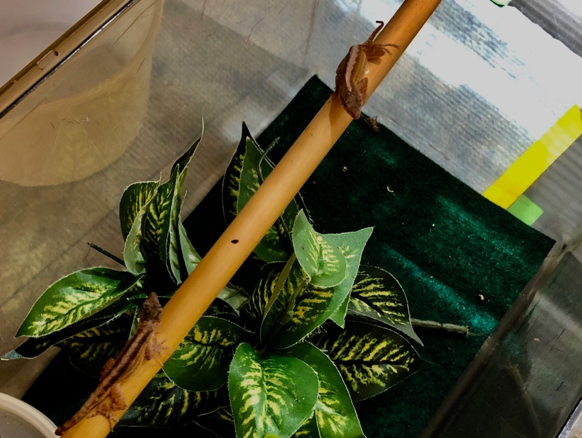
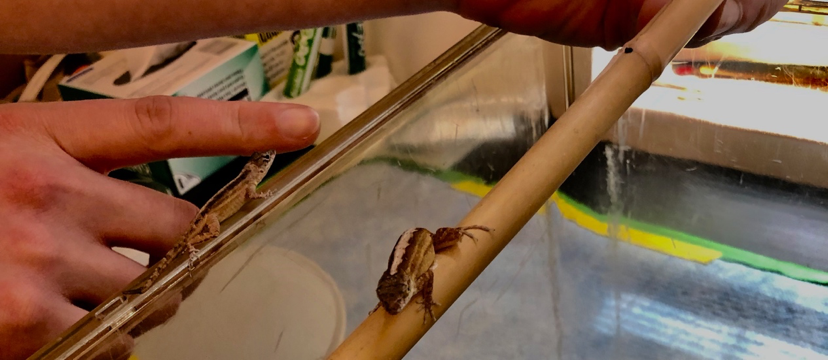
Dual PhD and Doctor of Veterinary Medicine student Ashley Rasys and her team have become the first to successfully make gene edits in reptiles, specifically the Anolis lizard. Rasys was able to edit the lizard’s genes to produce albino lizards. This breakthrough gives researchers the ability to study eye development in lizards, the animal with eyes most similar to those of humans.
Raised on a farm, Rasys had always had a love for animals, and jokes that her family raised her to be a vet. After finishing undergrad in 2013, Rasys gained early acceptance to the vet school at UGA and for the past four years has been duel enrolled in UGA’s graduate school. In an advanced biology course in her first year of vet school, Rasys first became exposed to research and the creative thought process that accompanied it. “I realized I really love this, and I became so passionate about trying to understand how things work,” said Rasys.
“Ashley really has this perfect combination of kind of just curiosity and intelligence and skill that made the project possible,” said Douglas Menke, a developmental geneticist at UGA and another leader on the project.
Reptiles have been an impenetrable species in terms of gene editing because of how they fertilize their eggs. They use internal fertilization, which means that many of them store sperm, then after the egg is fertilized a hard shell must develop in order for the embryo to form properly. In contrast, at fertilization of a mammal egg, a biologist can isolate a fertilized egg, make the gene edits, and then grow it in a petri dish before transferring it back to a host mother. This procedure is not possible with reptiles; scientists cannot remove the egg or make edits to it because the eggs are too fragile.
The team decided to take a new approach by using gene editing reagents (a reagent is a substance or mixture for use in chemical analysis or other reactions) not in fertilized eggs, but rather in the developing unfertilized eggs within the ovaries of the female lizards. They used the gene editing tool CRISPR, which stands for Clustered Regularly Interspaced Short Palindromic Repeats. Albinism is a recessive trait; therefore, the thought was that after injecting the unfertilized egg with the CRISPR gene editing reagents, it would take a few generations for the albino gene to be visible.
“We knew it would work. I think the big challenge when I was doing this experiment was a question of how much time it would take before we saw positive results, so I was pretty much floored when we got them quickly,” said Rasys.
“To our surprise we found that some of the hatchlings we generated had both the mother’s and father’s copy of the gene mutated and what we think is happening is the CRISPR gene editing reagents are really really stable. So even though we are injecting these gene editing solutions into immature eggs, those gene editing reagents are still active days or even weeks later when that egg is fully developed and ready to be fertilized,” said Menke.
The project got started when Rasys became interested in eye development. The human eye has a feature at the back of the retina called the fovea, a pit-like structure that has a high density of photo receptors. Many people with albinism have visionary defects related to the formation of the fovea. The exploration of how the fovea develops has stifled because the most commonly used animals in biomedical research do not have a fovea. The lizard does.
“The success of this project is a game-changer for developing potential new therapies that can be used to treat human eye disorders ranging from genetic mutations to macular degeneration,” said James Lauderdale, a cellular biologist at UGA and expert in eye development.
Rasys is mentored and supported by both Menke and Lauderdale. Both professors at UGA, Menke had the colony of lizards and Lauderdale had the expertise in eye development. “I came in and I was like ‘hey’ I want to do both,” said Rasys.
Rasys has been a true leader in this project, bringing forth her idea and watching over every aspect of the process.
“Ashley has an infectious passion for science that motivates me to be better at what I do every day. She is the heart of our research group, mentoring both the grad students and undergrads of our lab,” said Aaron-Jay Alcala, a graduate student on the project.
Rasys and her team released their paper on March 31, 2019, and by the following Friday The New York Times was reporting on it. Menke and Lauderdale both said that the project has been the highlight of their scientific careers.
“Being able to provide mentoring and kind of resource support to Ashley so that she could start literally from zero with a species of animal that nobody has been able to do any gene editing in and then see her and help her take that system all the way has been fantastic,” said Menke.
The next step for science will be to explore all the doors opened by Rasys and her team. But what is the next step for Rasys?
After finishing graduate school in May, Rasys will return to vet school in the fall. However, her plan is to use her vet degree to further her research and hopefully start her own lab in the future.
With a bright and promising career ahead of her, it won’t be long before students are learning about Ashley Rasys in classrooms worldwide.
 Kate Hester